Converse: “If I bring an umbrella then it rains today.”. Inverse: “If it doesn’t rain today then I won’t bring an umbrella.” Contrapositive: “If I won’t bring an umbrella, then it isn’t raining today”.
The conditional “When I stay up too late, it’s necessary that I sleep until noon” is “If I stay up too late, then it’s necessary that I sleep until noon.” Now find the other statements.
True. \(3\) is the only element of the set \(\{3\}\text{,}\) and is an element of \(C\text{,}\) so every element in \(\{3\}\) is an element of \(C\text{.}\)
\((D \cap \bar C) \cup \bar{A \cap B} = \{1, 3, 5, 7, 8, 9, 10\}.\) The set contains all elements that are either in \(D\) but not in \(C\) (i.e., \(\{7,8,9\}\)), or not in both \(A\) and \(B\) (i.e., \(\{1,3,5,7,8,9,10\}\)).
Venn diagram of \(\bar A \cap B \cap \bar C\text{.}\) Three circles are labeled A, B, and C. Only the part of B that doesn’t overlap A and doesn’t overlap C is shaded.
Venn diagram of \((A \cup B) \setminus C\text{.}\) Three circles are labeled A, B, and C. Only those parts of A and B that do not overlap C are shaded.
There are eight possible sets. \(B\) can be any of \(\{2,3,5\}\text{,}\)\(\{1,2,3,5\}\text{,}\)\(\{2,3,4, 5\}\text{,}\)\(\{2,3,5,6\}\text{,}\)\(\{1,2,3,4,5\}\text{,}\)\(\{1,2,3,5,6\}\text{,}\)\(\{2,3, 4, 5, 6\}\text{,}\)\(\and \{1, 2, 3, 4, 5, 6\}\)
There are many examples. Here’s one possibility: \(A = \{ a, b, c\}, B=\{b,c,d,e\}\text{.}\) Then the union is \(A \cup B = \{a, b, c, d, e\}\text{.}\)
The intersection of the set of red cards and the set of face cards is nonempty. It includes six cards: Jack of Hearts, Queen of Hearts, King of Hearts, Jack of Diamonds, Queen of Diamonds, and King of Diamonds.
\(2\Z \cap 3\Z\) is the set of all integers which are multiples of both 2 and 3 (these are the multiples of 6). Therefore \(2\Z \cap 3\Z = \{6x \st x \in \Z )\}\text{.}\)
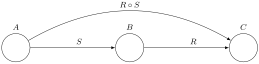
Let \(G:A \to B\) and let \(R:B \to C\text{.}\) The composition of \(R\) and \(S\), denoted by \(R\circ S\) is defined, for all \(a \in A\text{,}\) by \((R \circ S)(a) = R(S(a))\text{.}\)
Yes, the function is surjective. The codomain is \(\{1, 2, 3, 4\}\text{,}\) and each element of the codomain is mapped (the range equals the codomain).
\(f\) is not injective, but is surjective. Every integer is an output (of twice itself, for example), but some integers are outputs of more than one input: \(f(5) = 3 = f(6)\text{.}\)
Yes, since given any integer \(c\in \Z\) we can find two other integers \(m, n\) for which \(f(m,n) = c\text{;}\) for example, \(f(c,0) = c+0 = c\text{.}\)
Let \(x\) and \(y\) be elements of the domain \(\Z\text{.}\) Assume \(f(x) = f(y)\text{.}\) If \(x\) and \(y\) are both even, then \(f(x) = x+1\) and \(f(y) = y+1\text{.}\) Since \(f(x) = f(y)\text{,}\) we have \(x + 1 = y + 1\text{,}\) which implies \(x = y\text{.}\) Similarly, if \(x\) and \(y\) are both odd, then \(x - 3 = y-3\text{,}\) so again \(x = y\text{.}\) The only remaining possibility is that one is even and one is odd; but then one output is odd and the other is even, so they cannot be equal. Therefore \(f(x) = f(y)\) implies \(x = y\text{,}\) proving injectivity.
Let \(y\) be an element of the codomain \(\Z\text{.}\) We will show there is an element \(n\) of the domain (\(\Z\)) such that \(f(n) = y\text{.}\) If \(y\) is even, take \(n = y+3\text{.}\) Since \(y\) is even, \(n\) is odd, so \(f(n) = n-3 = y+3-3 = y\text{.}\) If \(y\) is odd, take \(n = y-1\text{.}\) Since \(y\) is odd, \(n\) is even, so \(f(n) = n+1 = y-1+1 = y\text{.}\) Thus every integer is an output, so \(f\) is surjective.
\(f\) is not injective. To prove this, we find two different elements of the domain that map to the same output: \(f(\{1\}) = 1\) and \(f(\{2\}) = 1\text{.}\)
\(f\) is not surjective. The largest subset of \(A\) is \(A\) itself, and \(|A| = 10\text{.}\) So no natural number greater than 10 will ever be an output.
\(f\inv(0) = \{\emptyset\}\text{.}\) It would be wrong to write \(f\inv(0) = \emptyset\text{,}\) because that would claim there is no input with output 0.
Then \(g\) must be surjective, but \(f\) need not be. A surjective composition means every target value of \(g\circ f\) is reached, which forces \(g\) to hit the codomain of the composition.
The floor function is surjective. Let \(c\in \Z\) be an integer in the codomain. Then consider \(a = c+0.1 \in \R\text{,}\) the domain. We have \(\lfloor a \rfloor = \lfloor c+0.1 \rfloor = c\text{.}\)
\begin{align*}
x\in A \cup (B \cup C) \amp\equiv (x \in A) \lor (x \in B \cup C)\\
\amp\equiv (x \in A) \lor ((x \in B) \lor (x \in C))\\
\amp\equiv x \in A \lor x \in B \lor x \in C\\
\amp\equiv (x \in A \lor x \in B) \lor x \in C\\
\amp\equiv (x \in A \cup B) \lor x \in C\\
\amp\equiv x \in (\in A \cup B) \cup C
\end{align*}
and so \(A \cup (B\cup C) = (A \cup B) \cup C\text{.}\)
Assume that \(x \in A \cup (B\cap C)\text{,}\) then:
\begin{align*}
x \in A \cup (B \cap C) \amp \equiv x \in A \lor (x \in B \cap C) \\
\amp \equiv x \in A \lor (x\in B \land x \in C)\\
\amp \equiv (x \in A \lor x\in B) \land (x \in A \lor \in C)\\
\amp \equiv (x \in A \cup B) \land (x \in A \cup C)\\
\amp \equiv x \in (A \cup B) \cap (A \cup C)
\end{align*}
and therefore \(A \cup (B \cap C) = (A \cup B) \cap (A \cup C)\text{.}\)
Applying DeMorgan’s laws many, many times and noting that the opposite of \(x\lt a\) is \(x \ge a\text{:}\)
\begin{align*}
\amp\neg \forall x \neg \forall y \neg(x \lt y \wedge \exists z (x \lt z \vee y \lt z)) \\
\amp\equiv \neg \forall x \neg \forall y \neg(x \lt y \wedge \exists z (x \lt z \vee y \lt z)) \\
\amp \equiv \exists x \neg \neg \forall y \neg(x \lt y \wedge \exists z (x \lt z \vee y \lt z)) \\
\amp \equiv \exists x \forall y \neg(x \lt y \wedge \exists z (x \lt z \vee y \lt z)) \\
\amp \equiv \exists x \forall y \neg(x \lt y ) \lor \neg ( \exists z (x \lt z \vee y \lt z)) ) \\
\amp \equiv \exists x \forall y \neg(x \lt y ) \lor \forall z \neg (x \lt z \vee y \lt z)) ) \\
\amp \equiv \exists x \forall y \neg(x \lt y ) \lor \forall z \neg (x \lt z) \land \neg (y \lt z))) \\
\amp \equiv \exists x \forall y (x \ge y ) \lor \forall z (x \ge z) \land (y \ge z)))
\end{align*}
This statement can be written \(\exists n \neg \exists x (x \le n)\text{.}\) It can be simplified as \(\exists n \forall x \neg (x \le n)\text{,}\) and even further as \(\exists n \forall x (x \gt n)\)
This statement can be written \(\neg \forall n \exists x \exists y (x \lt n \lt y)\)
\begin{align*}
\neg \forall n \exists x \exists y (x \lt n \lt y) \amp \equiv \exists n \neg \exists x \exists y (x \lt n \lt y) \\
\amp \equiv \exists n \forall x \neg \exists y (x \lt n \lt y) \\
\amp \equiv \exists n \forall x \forall y \neg (x \lt n \lt y)
\end{align*}
Let \(c\) come from the universe of colleges in the US, \(b\) be from the universe of buildings on a chosen campus and \(r\) be the rooms in a chosen building.
Start with the negation on the left and apply DeMorgan’s laws
\begin{align*}
\amp \neg \exists c \exists b \forall r (b \text{ on the campus of } c \text{ in
which } r \text{ is painted white})\\
\amp \equiv \forall c \forall b \exists r \neg(b \text{ on the campus of } c
\text{ in which } r \text{ is painted white})
\end{align*}
The deduction rule is valid. To see this, make a truth table which contains \(p \vee q\) and \(\neg p\) (and \(p\) and \(q\) of course). Look at the truth value of \(q\) in each of the rows that have \(p \vee q\) and \(\neg p\) true.
Let the universe of discourse be all creatures, \(L(x)\) be the statement “\(x\) is a lion,” \(C(x)\) be “\(x\) drinks coffee,” and \(F(x)\) is “\(x\) is fierce.”
True. Let \(a\) and \(b\) be integers. Assume both are even. Then \(a = 2k\) and \(b = 2j\) for some integers \(k\) and \(j\text{.}\) But then \(a+b = 2k + 2j = 2(k+j)\) which is even.
Let \(n\) be an integer. Assume \(n\) is even. Then \(n = 2k\) for some integer \(k\text{.}\) Thus \(8n = 16k = 2(8k)\text{.}\) Therefore \(8n\) is even.
The converse is false. That is, there is an integer \(n\) such that \(8n\) is even but \(n\) is odd. For example, consider \(n = 3\text{.}\) Then \(8n = 24\) which is even but \(n = 3\) is odd.
Assume that \(n\) is a prime number and is not solitary. \(\dots\) This contradicts our assumption. Thus if \(n\) is a prime number, \(n\) is solitary.
Proof by contradiction. Start of proof: Assume, for the sake of contradiction, that there are integers \(x\) and \(y\) such that \(x\) is a prime greater than 5 and \(x = 6y + 3\text{.}\) End of proof: … this is a contradiction, so there are no such integers.
Direct proof. Start of proof: Let \(n\) be an integer. Assume \(n\) is a multiple of 3. End of proof: Therefore \(n\) can be written as the sum of consecutive integers.
Proof by contrapositive. Start of proof: Let \(a\) and \(b\) be integers. Assume that \(a\) and \(b\) are even. End of proof: Therefore \(a^2 + b^2\) is even.
If a number isn’t a multiple of three, then it’s either 1 more than a multiple of three or 2 more than a multiple of three, that is, you’ll have two cases, either \(n=3k+1\) or \(3k+2\text{.}\)
Suppose \(\sqrt{3}\) were rational. Then \(\sqrt{3} = \frac{a}{b}\) for some integers \(a\) and \(b \ne 0\text{.}\) Without loss of generality, assume \(\frac{a}{b}\) is reduced. Now
(this is a direct proof): Assume that \(a\) is even \(b\) is a multiple of three. Then there exist integers \(k\) and \(l\) such that \(a=2k\) and \(b=3l\text{.}\) Then \(ab = (2k)(3l) = 6kl\text{.}\) Thus \(ab\) is a multiple of six.
Let \(n\) be an arbitrary integer, and suppose \(n\) is even. Then \(n = 2k\) for some integer \(k\text{.}\) Thus \(5n = 5\cdot 2k = 10k = 2(5k)\text{.}\) Since \(5k\) is an integer, we see that \(5n\) must be even. This completes the proof.
Suppose, contrary to stipulation that \(\log(7)\) is rational. Then \(\log(7) = \frac{a}{b}\) with \(a\) and \(b \ne 0\) integers. By properties of logarithms, this implies
Assume that \(a\) and \(b\) are both odd and that \(a^2 +b^2 = c^2\text{.}\) Then there exist integers \(k\) and \(l\) such that \(a=2k+1\) and \(b=2k+1\text{.}\)
This is a contradiction as we have a multiple of four being equal to something which is not a multiple of four. Thus, our original assumption was incorrect and therefore if \(a^2 + b^2 = c^2\text{,}\) we conclude that one of \(a\) or \(b\) is even.
Assume, to the contrary, that there is an integer solution, \((a, b)\text{,}\) to the equation \(x^2 = 4y + 3\) We’ll split this into four cases:
Case 1: \(x\) is odd and \(y\) is even. Then there exist integers \(k\) and \(l\) such that \(x=2k+1\) and \(y = 2l\text{.}\) Plugging this into the equation, we have:
Case 2: \(x\) is even and \(y\) is odd. Then there exist integers \(k\) and \(l\) such that \(x=2k\) and \(y = 2l+1\text{.}\) Plugging this into the equation, we have:
Case 3: \(x\) and \(y\) are both even. Then there exist integers \(k\) and \(l\) such that \(x=2k\) and \(y = 2l\text{.}\) Plugging this into the equation, we have:
Case 4: \(x\) and \(y\) are both odd. Then there exist integers \(k\) and \(l\) such that \(x=2k\) and \(y = 2l\text{.}\) Plugging this into the equation, we have:
Since we’ve exhausted every possible combination of integer solutions, we conclude that there is no integer solution to the equation \(x^2 = 4y+3\text{.}\)
Notice that in every row for which both \(p \to q\) and \(p \to r\) is true, so is \(p \to (q \wedge r)\text{.}\) Therefore, whenever the premises of the argument are true, so is the conclusion. In other words, the deduction rule is valid.
The statement is true. If \(n\) is an even integer less than or equal to 7, then the only way it could not be negative is if \(n\) was equal to 0, 2, 4, or 6.
There is an integer \(n\) such that \(n\) is even and \(n \le 7\) but \(n\) is not negative and \(n \not\in \{0,2,4,6\}\text{.}\) This is false, since the original statement is true.
For all integers \(n\text{,}\) if \(n\) is not negative and \(n \not\in\{0,2,4,6\}\) then \(n\) is odd or \(n > 7\text{.}\) This is true, since the contrapositive is equivalent to the original statement (which is true).
For all integers \(n\text{,}\) if \(n\) is negative or \(n \in \{0,2,4,6\}\) then \(n\) is even and \(n \le 7\text{.}\) This is false. \(n = -3\) is a counterexample.
For any number \(x\text{,}\) if it is the case that adding any number to \(x\) gives that number back, then multiplying any number by \(x\) will give 0. This is true (of the integers or the reals). The “if” part only holds if \(x = 0\text{,}\) and in that case, anything times \(x\) will be 0.
The converse in words is this: for any number \(x\text{,}\) if everything times \(x\) is zero, then everything added to \(x\) gives itself. Or in symbols: \(\forall x (\forall z (x \cdot z = 0) \to \forall y (x + y = y))\text{.}\) The converse is true: the only number which when multiplied by any other number gives 0 is \(x = 0\text{.}\) And if \(x = 0\text{,}\) then \(x + y = y\text{.}\)
The contrapositive in words is: for any number \(x\text{,}\) if there is some number which when multiplied by \(x\) does not give zero, then there is some number which when added to \(x\) does not give that number. In symbols: \(\forall x (\exists z (x\cdot z \ne 0) \to \exists y (x + y \ne y))\text{.}\) We know the contrapositive must be true because the original implication is true.
The negation: there is a number \(x\) such that any number added to \(x\) gives the number back again, but there is a number you can multiply \(x\) by and not get 0. In symbols: \(\exists x (\forall y (x + y = y) \wedge \exists z (x \cdot z \ne 0))\text{.}\) Of course since the original implication is true, the negation is false.
If the Broncos don’t win the Super Bowl, then they didn’t play in the Super Bowl. Alternatively, if the Broncos play in the Super Bowl, then they will win the Super Bowl.
The converse is: for all integers \(n\text{,}\) if \(7n\) is odd, then \(n\) is odd. We will prove this by contrapositive.
Proof.
Let \(n\) be an integer. Assume \(n\) is not odd. Then \(n = 2k\) for some integer \(k\text{.}\) So \(7n = 14k = 2(7k)\) which is to say \(7n\) is even. Therefore \(7n\) is not odd.
Assume that \(a, b, c\) are integers with \(a \ne 0\) and \(c\ne 0\) such that \(ac \divides bc\text{.}\) Then there exists an integer \(m\) such \(bc = acm\)
Since \(c \ne 0\text{,}\) we can divide both sides of the equation by \(c\text{,}\) yielding the equality \(b = am\text{.}\) Thus \(a \divides b\text{.}\)
One possible counterexample here is \(a = 2, b=7, c=7, b=2, m=5\text{.}\) Then we can see \(2\equiv 7\pmod 5\) satisfies both parts of the hypothesis, but \(2^7 \equiv 3 \pmod 5\) while \(7^2 \equiv 4 \pmod 5\text{.}\)
(by contraposition). Assume that \(n\) is not a number of the form \(n=6k+1\) or \(n=6k-1\) for some integer \(k\text{.}\) This gives us four total cases:
Thus if \(n\) is not of the form \(n=6k+1\) or \(n=6k-1\) for some integer \(k\text{,}\)\(n\) is not prime. By contraposition, if \(n\) is a prime greater than three then \(n\) is of the form either \(n=6k+1\) or \(n=6k-1\) for some integer \(k\text{.}\)
Our proof will go like this: factor \(n\) into three parts, \(p_1, p_2, \and b\) where \(p_1 \and p_2\) are prime and \(b\) is whatever is left with the factorization, such as \(10 = 2\cdot5\cdot1\) where \(b=1\) or \(60=2\cdot5\cdot6\) where \(b=6\text{,}\) but assuming those prime factors are bigger than \(\sqrt{n}\text{,}\) and look for the contradiction.
Assume, to the contrary, that every prime divisor of \(n\) is greater than \(\sqrt{n}\text{.}\) Since \(n\) is composite, it has at least two prime factors, \(p_1, p_2\) so that \(n = p_1 p_2 b\) where \(b\) is some positive integer. But since \(p_1 \and p_2\) are a prime divisors of \(n\text{,}\) by our assumption, \(p_1 \gt \sqrt{n} \and p_2 \gt \sqrt{n}\text{.}\) So:
\begin{equation*}
n = p_1 p_2 b \gt \sqrt{n} \cdot \sqrt{n} \cdot b = nb
\end{equation*}
But since \(n\gt 1 \) and \(b\in \Z^+\text{,}\)\(n\gt nb\) is a contradiction. This means our original assumption, that every prime factor of \(n\) was greater than \(\sqrt{n}\) was wrong, and therefore we conclude that \(n\) has a prime factor less than \(\sqrt{n}\text{.}\)
Here, since the coefficient of \(x\) isn’t relatively prime to the modulus there are either multiple answers per modulus or no solution.
Each of \(x \equiv 2 \pmod{9}\text{,}\)\(x\equiv 5 \pmod{9}\text{,}\) and \(x \equiv 8 \pmod{9}\) satisfy the given equation. We can summarize this as \(x \equiv 2 \pmod{3}\)
Since \(\gcd(3,26) = 1\text{,}\) there is a unique inverse. Using the Euclidean Algorithm we find that \(3^{-1} \equiv 9 \pmod{26}\text{.}\) Doing the algebra:
\begin{align*}
3x \amp= 19 \pmod{26}\\
(3^{-1})3x \amp=(3^{-1}) 19 \pmod{26}\\
x \amp\equiv (9) 19 \pmod{26}\\
x \amp\equiv 171 \pmod{26}\\
x \amp\equiv 15 \pmod{26}
\end{align*}
Here \(\gcd(13, 26) = 2\) so there is no unique solution. Instead, there are either no solutions or two solutions! But since the gcd doesn’t divide \(7\text{,}\) there are in fact no solutions to this congruence.
Since \(\gcd(8, 426) = 2\text{.}\) Like the previous question there are either no solutions or two solutions. This time since the gcd does divide 16, we will have two solutions! The first is obviously \(x=2\text{,}\) and the second will be, applying Note 3.4.12:
\begin{align*}
x \amp= 2 + \dfrac{426}{2}\\
\amp= 215
\end{align*}
This time the modulus is 425, so we have \(\gcd(425, 8) = 1\) meaning a unique solution exists the system. The Euclidean algorithm finds that \(8^{-1} = -53 \pmod{425}\text{,}\) and solving the expression gives:
\begin{align*}
8x \amp= 16 \pmod{426}\\
(8^{-1})8x \amp=(8^{-1}) 16 \pmod{425}\\
x \amp\equiv (-53) 16 \pmod{425}\\
x \amp\equiv -848 \pmod{425}\\
x \amp\equiv 2 \pmod{425}
\end{align*}
... which actually is both obvious and hilarious. It shows that even if we don’t notice the obvious solution, the method will give us the correct result!
This time, as before, \(\gcd(8, 426) = 2\text{,}\) so there are either zero or two solutions. But since there the gcd doesn’t divide \(23\text{,}\) there is no solution to the congruence.
This one’s a lot of fun, so let’s do it in a lot of detail. This is approach Blaise Pascal used to discover the formula in his 1654 Traité du triangle arithmétique.
We have from Example 4.1.15 that \(\displaystyle \sum_{j=1}^n j = \dfrac{n(n+1)}{2}\) and if we add \(1\) a total of \(n\) times, we have \(\displaystyle \sum_{j=1}^n 1 = n\text{.}\) Plugging these in, we find:
The recurrence is \(a_n = 3a_{n-1} + 4a_{n-2}\text{.}\) The solution with the given initial conditions is \(a_n = \frac{4^{n+1}}{5} + \frac{(-1)^n}{5}\)
We must prove that \(1 + 2 + 2^2 + 2^3 + \cdots +2^n = 2^{n+1} - 1\) for all \(n \in \N\text{.}\) Thus let \(P(n)\) be the statement \(1 + 2 + 2^2 + \cdots + 2^n = 2^{n+1} - 1\text{.}\) We will prove that \(P(n)\) is true for all \(n \in \N\text{.}\) First we establish the base case, \(P(0)\text{,}\) which claims that \(1 = 2^{0+1} -1\text{.}\) Since \(2^1 - 1 = 2 - 1 = 1\text{,}\) we see that \(P(0)\) is true. Now for the inductive case. Assume that \(P(k)\) is true for an arbitrary \(k \in \N\text{.}\) That is, \(1 + 2 + 2^2 + \cdots + 2^k = 2^{k+1} - 1\text{.}\) We must show that \(P(k+1)\) is true (i.e., that \(1 + 2 + 2^2 + \cdots + 2^{k+1} = 2^{k+2} - 1\)). To do this, we start with the left-hand side of \(P(k+1)\) and work to the right-hand side:
Let \(P(n)\) be the statement \(1+3 +5 + \cdots + (2n-1) = n^2\text{.}\) We will prove that \(P(n)\) is true for all \(n \ge 1\text{.}\) First the base case, \(P(1)\text{.}\) We have \(1 = 1^2\) which is true, so \(P(1)\) is established. Now the inductive case. Assume that \(P(k)\) is true for some fixed arbitrary \(k \ge 1\text{.}\) That is, \(1 + 3 + 5 + \cdots + (2k-1) = k^2\text{.}\) We will now prove that \(P(k+1)\) is also true (i.e., that \(1 + 3 + 5 + \cdots + (2k+1) = (k+1)^2\)). We start with the left-hand side of \(P(k+1)\) and work to the right-hand side:
Let \(P(n)\) be the statement \(2^n \lt n!\text{.}\) We will show \(P(n)\) is true for all \(n \ge 4\text{.}\) First, we check the base case and see that yes, \(2^4 \lt 4!\) (as \(16 \lt 24\)) so \(P(4)\) is true. Now for the inductive case. Assume \(P(k)\) is true for an arbitrary \(k \ge 4\text{.}\) That is, \(2^k \lt k!\text{.}\) Now consider \(P(k+1)\text{:}\)\(2^{k+1} \lt (k+1)!\text{.}\) To prove this, we start with the left side and work to the right side.
Therefore \(2^{k+1} \lt (k+1)!\) so we have established \(P(k+1)\text{.}\) Thus by the principle of mathematical induction \(P(n)\) is true for all \(n \ge 4\text{.}\)
which is exactly what we needed to show. Thus, by the principle of mathematical induction, the original statement \(1^2 +2^2 +3^2+...+n^2 = \frac{n(n+1)(2n+1)}{6}\) is true for all integers \(n\ge 1\text{.}\)
Let \(P(n)\) be the statement that \(n + 3 \lt n + 7\text{.}\) We will prove that \(P(n)\) is true for all \(n \in \N\text{.}\) First, note that the base case holds: \(0+3 \lt 0+7\text{.}\) Now assume for induction that \(P(k)\) is true. That is, \(k+3 \lt k+7\text{.}\) We must show that \(P(k+1)\) is true. Now since \(k + 3 \lt k + 7\text{,}\) add 1 to both sides. This gives \(k + 3 + 1 \lt k + 7 + 1\text{.}\) Regrouping \((k+1) + 3 \lt (k+1) + 7\text{.}\) But this is simply \(P(k+1)\text{.}\) Thus by the principle of mathematical induction \(P(n)\) is true for all \(n \in \N\text{.}\)
The problem here is that while \(P(0)\) is true, and while \(P(k) \imp P(k+1)\) for some values of \(k\text{,}\) there is at least one value of \(k\) (namely \(k = 99\)) when that implication fails. For a valid proof by induction, \(P(k) \imp P(k+1)\) must be true for all values of \(k\) greater than or equal to the base case.
Inductive case: Assume \(P(k)\) is true for arbitrary \(k\ge 2\) (that the number of handshakes among \(k\) people is \(\frac{k(k-1)}{2}\text{.}\) What happens if a \(k+1\)st person shows up? How many new handshakes take place? The new person must shake hands with everyone there, which is \(k\) new handshakes. So the total is now \(\frac{k(k-1)}{2} + k = \frac{(k+1)k}{2}\text{,}\) as needed.
The idea here is that if we take the logarithm of \(a^n\text{,}\) we can increase \(n\) by 1 if we multiply by another \(a\) (inside the logarithm). This results in adding 1 more \(\log(a)\) to the total.
Let \(P(n)\) be the statement \(\log(a^n) = n \log(a)\text{.}\) The base case, \(P(2)\) is true, because \(\log(a^2) = \log(a\cdot a) = \log(a) + \log(a) = 2\log(a)\text{,}\) by the product rule for logarithms. Now assume, for induction, that \(P(k)\) is true. That is, \(\log(a^k) = k\log(a)\text{.}\) Consider \(\log(a^{k+1})\text{.}\) We have
with the last equality due to the inductive hypothesis. But this simplifies to \((k+1) \log(a)\text{,}\) establishing \(P(k+1)\text{.}\) Therefore by the principle of mathematical induction, \(P(n)\) is true for all \(n \ge 2\text{.}\)
You are allowed to assume the base case. For the inductive case, group all but the last function together as one sum of functions, then apply the usual sum of derivatives rule, and then the inductive hypothesis.
Inductive step: Assume that \(P(k)\) is true for some integer \(k \ge 0\text{.}\) That is, \(F_0 + F_1 + F_2 + \cdots + F_{k} = F_{k+2} - 1\text{.}\) Now consider
Let \(P(n)\) be the statement \(F_0 + F_2 + F_4 + \cdots + F_{2n} = F_{2n+1} - 1\text{.}\) We will show that \(P(n)\) is true for all \(n \ge 0\text{.}\) First the base case is easy because \(F_0 = 0\) and \(F_1 = 1\) so \(F_0 = F_1 - 1\text{.}\) Now consider the inductive case. Assume \(P(k)\) is true, that is, assume \(F_0 + F_2 + F_4 + \cdots + F_{2k} = F_{2k+1} - 1\text{.}\) To establish \(P(k+1)\) we work from left to right:
Therefore \(F_0 + F_2 + F_4 + \cdots + F_{2k+2} = F_{2k+3} - 1\text{,}\) which is to say \(P(k+1)\) holds. Therefore by the principle of mathematical induction, \(P(n)\) is true for all \(n \ge 0\text{.}\)
Inductive step: Assume that there is an integer \(k \ge 0\) such that \(P(m)\) is true for all \(0\le m \le k\text{.}\) That is, \(m\) is either a Fibonacci number or the sum of distinct Fibonacci numbers. Now let’s consider the next number, \(k+1\text{:}\)
Case 2: If \(k+1\) is not a Fibonacci number, then let \(F_m\) be the largest Fibonacci number less than \(k+1\text{.}\) Since \(k+1 - F_m \le k\) then we have that \(k+1 - F_m\) is the sum of distinct Fibonacci numbers, by inductive hypothesis.
Inductive step: Assume that \(P(k)\) is true for some integer \(k\ge 1\text{.}\) That is, \(F_1 + F_3 + F_5 + \dots + F_{2k -1} = F_{2k}\) and consider:
Let \(P(n)\) be the statement “there is a strictly increasing sequence \(a_1, a_2, \ldots, a_n\) with \(a_n \lt 100\text{.}\)” We will prove \(P(n)\) is true for all \(n \ge 1\text{.}\) First we establish the base case: \(P(1)\) says there is a single number \(a_1\) with \(a_1 \lt 100\text{.}\) This is true – take \(a_1 = 0\text{.}\) Now for the inductive step, assume \(P(k)\) is true. That is there exists a strictly increasing sequence \(a_1, a_2, a_3, \ldots, a_k\) with \(a_k \lt 100\text{.}\) Now consider this sequence, plus one more term, \(a_{k+1}\) which is greater than \(a_k\) but less than \(100\text{.}\) Such a number exists, for example, the average between \(a_k\) and 100. So then \(P(k+1)\) is true, so we have shown that \(P(k) \imp P(k+1)\text{.}\) Thus by the principle of mathematical induction, \(P(n)\) is true for all \(n \in \N\text{.}\)
(Alternative idea to the below proof) In the inductive step add and subtract \(7^k\text{.}\) That is, you’ll have \(7\cdot 7^{k} - 1 - 7^k + 7^k\text{.}\) Now algebra.
Let \(P(n)\) be the statement “6 divides \(7^n - 1\text{.}\)” We will show \(P(n)\) is true for all \(n \in \N\text{.}\) First we establish the base case, \(P(0)\text{.}\) Since \(7^0 - 1 = 0\text{,}\) and \(0\) is a multiple of 6, \(P(0)\) is true. Now for the inductive case. Assume \(P(k)\) holds for an arbitrary \(k \in \N\text{.}\) That is, 6 divides \(7^k - 1\text{,}\) or in other words, \(7^k - 1 = 6j\) for some integer \(j\text{.}\) Now consider \(7^{k+1} - 1\text{:}\)
\begin{align*}
7^{k+1} - 1 ~ \amp = 7^{k+1} - 7 + 6 \amp \text{by cleverness:} -1 = -7 + 6\\
\amp = 7(7^k - 1) + 6 \amp \text{factor out a 7 from the first two terms}\\
\amp = 7(6j) + 6 \amp \text{by the inductive hypothesis}\\
\amp = 6(7j + 1) \amp \text{factor out a 6}
\end{align*}
Therefore 6 divides \(7^{k+1} - 1\text{,}\) or in other words, \(P(k+1)\) is true. Therefore by the principle of mathematical induction, \(P(n)\) is true for all \(n \in \N\text{.}\)
To maximize the number of elements in common between \(A\) and \(B\text{,}\) make \(A \subset B\text{.}\) This would give \(\card{A \cap B} = 10\text{.}\)
\(64 + 64 - 0 = 128\) words. There are 64 words which start with “aha” and another 64 words that end with “bah.” Perhaps we over counted the words that both start with “aha” and end with “bah”, but since the words are only 5 letters long, there are no such words.
\((8\cdot 7\cdot 6\cdot 5\cdot 4) - 3\cdot (5\cdot 4) = 6660\) words. All the words minus the bad ones. The taboo word can be in any of three positions (starting with letter 1, 2, or 3) and for each position we must choose the other two letters (from the remaining 5 letters).
There are a total of four different remainders modulo 4. According to the Generalized Pigeonhole Principal, if we have 5 numbers divided among four different remainders, \(\left\lceil \dfrac{5}{4} \right\rceil = 2\) of them have to have the same remainder. Thus they differ by a multiple of four.
Despite its name, we are not looking for a combination here. The order in which the three numbers appears matters. There are \(P(40,3) = 40\cdot 39 \cdot 38\) different possibilities for the “combination”. This is assuming you cannot repeat any of the numbers (if you could, the answer would be \(40^3\)).
After the first letter (a), we must rearrange the remaining 7 letters. There are only two letters (s and e), so this is really just a bit-string question (think of s as 1 and e as 0). Thus there \({7 \choose 2} = 21\) anagrams starting with “a”.
\({20 \choose 4}{16 \choose 4}{12 \choose 4}{8 \choose 4}{4 \choose 4}\) ways. Pick 4 out of 20 people to be in the first foursome, then 4 of the remaining 16 for the second foursome, and so on (use the multiplicative principle to combine).
\(5!{15 \choose 3}{12 \choose 3}{9 \choose 3}{6 \choose 3}{3 \choose 3}\) ways. First determine the tee time of the 5 board members, then select 3 of the 15 non board members to golf with the first board member, then 3 of the remaining 12 to golf with the second, and so on.
Answer the question “If a pizza place offers \(n\) toppings, how many pizzas can you build using any number of toppings using each topping no more than once?”
Answer 2: We break this question down into cases, based on what the larger of the two elements in the subset is. The larger element can’t be 1, since we need at least one element smaller than it.
And so on. When the larger element is \(n+1\text{,}\) there are \(n\) choices for the smaller element. Since each two element subset must be in exactly one of these cases, the total number of two element subsets is \(1 + 2 + 3 + \cdots + n\text{.}\)
She has \({15 \choose 6}\) ways to select the 6 bridesmaids, and then for each way, has 6 choices for the maid of honor. Thus she has \({15 \choose 6}6\) choices.
She has 15 choices for who will be her maid of honor. Then she needs to select 5 of the remaining 14 friends to be bridesmaids, which she can do in \({14 \choose 5}\) ways. Thus she has \(15 {14 \choose 5}\) choices.
We have answered the question, how many wedding parties can the bride choose from, in two ways. The first way gives the left-hand side of the identity and the second way gives the right-hand side of the identity. Therefore the identity holds.
Question: You have a large container filled with ping-pong balls, all with a different number on them. You must select \(k\) of the balls, putting two of them in a jar and the others in a box. How many ways can you do this?
Answer 1: First select 2 of the \(n\) balls to put in the jar. Then select \(k-2\) of the remaining \(n-2\) balls to put in the box. The first task can be completed in \({n \choose 2}\) different ways, the second task in \({n-2 \choose k-2}\) ways. Thus there are \({n \choose 2}{n-2 \choose k-2}\) ways to select the balls.
Answer 2: First select \(k\) balls from the \(n\) in the container. Then pick 2 of the \(k\) balls you picked to put in the jar, placing the remaining \(k-2\) in the box. The first task can be completed in \({n \choose k}\) ways, the second task in \({k \choose 2}\) ways. Thus there are \({n \choose k}{k \choose 2}\) ways to select the balls.
The word contains 9 letters: 3 “r”s, 2 “a”s and 2 “e”s, along with an “n” and a “g”. We could first select the positions for the “r”s in \({9 \choose 3}\) ways, then the “a”s in \({6 \choose 2}\) ways, the “e”s in \({4 \choose 2}\) ways and then select one of the remaining two spots to put the “n” (placing the “g” in the last spot). This gives the answer
Answer 1: There are \(n\) choices for the first letter, \(n-1\) choices for the second letter, \(n-2\) choices for the third letter, and so on until \(n - (k-1)\) choices for the \(k\)th letter (since \(k-1\) letters have already been assigned at that point). The product of these numbers can be written \(\frac{n!}{(n-k)!}\) which is \(P(n,k)\text{.}\) Therefore there are \(P(n,k)\) words.
Answer 2: First pick \(k\) letters to be in the word from the \(n\) choices. This can be done in \({n \choose k}\) ways. Now arrange those letters into a word. There are \(k\) choices for the first letter, \(k-1\) choices for the second, and so on, for a total of \(k!\) arrangements of the \(k\) letters. Thus the total number of words is \({n \choose k}k!\text{.}\)
Answer 2: Break this up into cases by what the “middle” (third smallest) element of the 5 element subset is. The smallest this could be is a 3. In that case, we have \({2 \choose 2}\) choices for the numbers below it, and \({n \choose 2}\) choices for the numbers above it. Alternatively, the middle number could be a 4. In this case there are \({3 \choose 2}\) choices for the bottom two numbers and \({n-1 \choose 2}\) choices for the top two numbers. If the middle number is 5, then there are \({4 \choose 2}\) choices for the bottom two numbers and \({n-2 \choose 2}\) choices for the top two numbers. An so on, all the way up to the largest the middle number could be, which is \(n+1\text{.}\) In that case there are \({n \choose 2}\) choices for the bottom two numbers and \({2 \choose 2}\) choices for the top number. Thus the number of 5 element subsets is