We’re going to begin this section by doing a lot of tedious looking algebra, but then we’ll make a connection to what we’ve been doing. There’s a reason! Later in the section, we will introduce a new method of proof called, “combinatorial proof” in which we’re able to verify mathematical statements by counting!
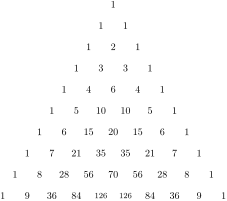
If we arrange the coefficients of the binomials (binomial coefficients) in a triangle, we can find many really neat patterns. In the West, this is usually called “Pascal’s Triangle” after Blaise Pascal (1600’s), though it was also discussed by the Chinese author Yang Hui (1200’s) and it’s called “Yang Hui’s triangle” in China.
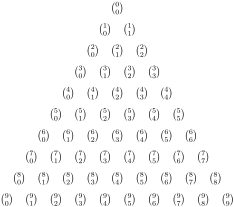
A connection that Pascal did make in Traité du triangle arithmétique (Treatise on the Arithmetic Triangle) is that the entries in the table are actually combinations! Here’s the triangle again, but written with combinations And rather than going through further linguistic torture, we can now refer to “combinations” as “binomial coefficients”.
Take a moment to compare the binomials we expanded in the beginning of the section with the summation in the Binomial Theorem to see how it all fits together.
Our goal for the remainder of the section is to give proofs of binomial identities. We’ll start with a very tedious algebraic way to do it and then introduce a new proof technique to deal with the same identity.
That algebra had some fun manipulations if you’re into that kind of thing, but as 15th century mathematician Gerolamo Cardano said Ars Magna, it “is as refined as it is useless.”
Here we introduce a new method of providing mathematical statements. Our goal is to show that an equality is true by counting each side of the equation differently, but showing that we’ve counted the same objects. In order to do this, we will make the following connection for things that binomial coefficients might represent:
\(\binom{n}{k}\) is the number of ways to select \(k\) objects from a set of \(n\) objects.
Answer two: Pick any element of the set. That element is either included in a subset, or it is not.
How many subsets contain this element? We will be picking from the remaining \(n-1\) elements. Since we want the subsets to have \(k\) elements, but we already have one of them, we have a total of \(\binom{n-1}{k-1}\) such subsets.
How many subsets do not contain this element? We will be picking from the remaining \(n-1\) elements. Since we want the subsets to have \(k\) elements, we have \(\binom{n-1}{k}\) such subsets.
Answer: Instead of picking the cookies we want, let’s pick the cookies we don’t want. We will pick the \(n-k\) cookies that we don’t want, and there’s \(\binom{n}{n-k}\) ways to do this.
Question: If there are \(n\) meats and \(n\) non-meat toppings for a pizza, how many \(n\) topping pizzas can be made? (if we don’t allow repeat toppings)
Answer: There are \(\binom{2n}{n}\) total pizzas that can be made.
If we want no meats, then we’ll select no meats and \(n\) non-meats. These are independent of one another, so we multiply: \(\binom{n}{0}\binom{n}{n}\)
If we want 1 meat, then we’ll select \(n-1\) non-meats for the rest of the toppings. These are independent of one another, so we multiply: \(\binom{n}{1}\binom{n}{n-1}\)
If we want 2 meats, then we’ll select \(n-2\) non-meats for the rest of the toppings. These are independent of one another, so we multiply: \(\binom{n}{2}\binom{n}{n-2}\)
If we want n meats, then we’ll select \(n-n=0\) non-meats for the rest of the toppings. These are independent of one another, so we multiply: \(\binom{n}{n}\binom{n}{0}\)
because each of these pizzas are completely different than the rest (have different numbers of meats), the addition principle says to add them all together:
Answer the question “If a pizza place offers \(n\) toppings, how many pizzas can you build using any number of toppings using each topping no more than once?”
Answer 2: We break this question down into cases, based on what the larger of the two elements in the subset is. The larger element can’t be 1, since we need at least one element smaller than it.
And so on. When the larger element is \(n+1\text{,}\) there are \(n\) choices for the smaller element. Since each two element subset must be in exactly one of these cases, the total number of two element subsets is \(1 + 2 + 3 + \cdots + n\text{.}\)
A woman is getting married. She has 15 best friends but can only select 6 of them to be her bridesmaids, one of which needs to be her maid of honor. How many ways can she do this?
She has \({15 \choose 6}\) ways to select the 6 bridesmaids, and then for each way, has 6 choices for the maid of honor. Thus she has \({15 \choose 6}6\) choices.
She has 15 choices for who will be her maid of honor. Then she needs to select 5 of the remaining 14 friends to be bridesmaids, which she can do in \({14 \choose 5}\) ways. Thus she has \(15 {14 \choose 5}\) choices.
We have answered the question, how many wedding parties can the bride choose from, in two ways. The first way gives the left-hand side of the identity and the second way gives the right-hand side of the identity. Therefore the identity holds.
Question: You have a large container filled with ping-pong balls, all with a different number on them. You must select \(k\) of the balls, putting two of them in a jar and the others in a box. How many ways can you do this?
Answer 1: First select 2 of the \(n\) balls to put in the jar. Then select \(k-2\) of the remaining \(n-2\) balls to put in the box. The first task can be completed in \({n \choose 2}\) different ways, the second task in \({n-2 \choose k-2}\) ways. Thus there are \({n \choose 2}{n-2 \choose k-2}\) ways to select the balls.
Answer 2: First select \(k\) balls from the \(n\) in the container. Then pick 2 of the \(k\) balls you picked to put in the jar, placing the remaining \(k-2\) in the box. The first task can be completed in \({n \choose k}\) ways, the second task in \({k \choose 2}\) ways. Thus there are \({n \choose k}{k \choose 2}\) ways to select the balls.
How many ways are there to rearrange the letters in the word “rearrange”? Answer this question in at least two different ways to establish a binomial identity.
The word contains 9 letters: 3 “r”s, 2 “a”s and 2 “e”s, along with an “n” and a “g”. We could first select the positions for the “r”s in \({9 \choose 3}\) ways, then the “a”s in \({6 \choose 2}\) ways, the “e”s in \({4 \choose 2}\) ways and then select one of the remaining two spots to put the “n” (placing the “g” in the last spot). This gives the answer
Answer 1: There are \(n\) choices for the first letter, \(n-1\) choices for the second letter, \(n-2\) choices for the third letter, and so on until \(n - (k-1)\) choices for the \(k\)th letter (since \(k-1\) letters have already been assigned at that point). The product of these numbers can be written \(\frac{n!}{(n-k)!}\) which is \(P(n,k)\text{.}\) Therefore there are \(P(n,k)\) words.
Answer 2: First pick \(k\) letters to be in the word from the \(n\) choices. This can be done in \({n \choose k}\) ways. Now arrange those letters into a word. There are \(k\) choices for the first letter, \(k-1\) choices for the second, and so on, for a total of \(k!\) arrangements of the \(k\) letters. Thus the total number of words is \({n \choose k}k!\text{.}\)
Answer 2: Break this up into cases by what the “middle” (third smallest) element of the 5 element subset is. The smallest this could be is a 3. In that case, we have \({2 \choose 2}\) choices for the numbers below it, and \({n \choose 2}\) choices for the numbers above it. Alternatively, the middle number could be a 4. In this case there are \({3 \choose 2}\) choices for the bottom two numbers and \({n-1 \choose 2}\) choices for the top two numbers. If the middle number is 5, then there are \({4 \choose 2}\) choices for the bottom two numbers and \({n-2 \choose 2}\) choices for the top two numbers. An so on, all the way up to the largest the middle number could be, which is \(n+1\text{.}\) In that case there are \({n \choose 2}\) choices for the bottom two numbers and \({2 \choose 2}\) choices for the top number. Thus the number of 5 element subsets is